Using scaffoldings to improve tissue regeneration has been a staple of medicine for thousands of years, with the Egyptians and Romans using splints to aid recovery of bone fractures. Bringing this technology into the 21st century, next-generation internal scaffoldings are being developed using polypeptide amphiphile (PA) based nanofiber gel matrices. These scaffoldings can be non-invasively injected, and can provide both a platform for tissue regeneration, and a delivery mechanism for cell therapy or bioactive signalling. Following studies showing the dependence of cell biology on gel stiffness, Pashuk and colleagues endeavoured to tailor the mechanical properties of the gel matrix by altering the molecular structure of constituent PAs, and in doing so reach for a key target in regenerative medicine.
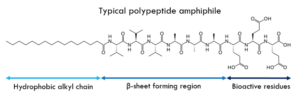
The stiffness of the gel matrix was tailored by adjusting the chemical structure of the β-sheet forming region of the PAs. This method was chosen because in self-assembly, the PAs first aggregate by hydrophobic collapse, then form the nanofibers as a result of the secondary structure caused by the alignment of β-sheets. The outer peptide is tailored for biological signalling and for control over self-assembly by ionisation of side-chains. The β-sheets are the main regulator of the fibre structure, and forces between sheets dictate the rigidity of the fibre. Valine highly favours β-sheet formation, and alanine favours α-helix formation. By varying the sequencing and length of the valine/alanine peptide, the β-sheets are distorted and hydrogen bonding between layers is affected, altering the stiffness of the entire gel matrix.
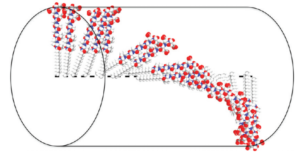
Circular dichroism was used to confirm distortion to the β-sheets by observing a red-shift relative to the expected signal. The distortions lead to an angling of sheets relative to one another, which results in the PAs forming a twisted geometry around the central axis of the fibre as illustrated in figure 2. A combination of Fourier transform infrared spectroscopy (FTIR) and rheological analysis indicated PAs which form stiffer gels tend to have their internal hydrogen bonds aligned with the fibre axis, which is consistent with distortions to the β-sheets decreasing fibre stiffness. It is also possible that the twisted geometry may have affected the fibre length and entanglement, however this was not able to be studied in this paper due to technical limitations. The paper found that all factors tested, including β-sheet length, valine-alanine ratio, and sequencing of the amino acids, affected the gel stiffness to varying degrees. Combining these was shown to be a highly effective method of tuning gel stiffness, and a step towards improved tissue scaffoldings for regenerative medicine.
References
Pashuck, E. T., Cui, H., & Stupp, S. I. (2010). Tuning Supramolecular Rigidity of Peptide Fibers through Molecular Structure. J. Am. Chem. Soc. Journal of the American Chemical Society, 132(17), 6041-6046. doi:10.1021/ja908560n