Tuning Rigidity of Tissue Scaffolds

Using scaffoldings to improve tissue regeneration has been a staple of medicine for thousands of years, with the Egyptians and Romans using splints to aid recovery of bone fractures. Bringing this technology into the 21st century, next-generation internal scaffoldings are being developed using polypeptide amphiphile (PA) based nanofiber gel matrices. These scaffoldings can be non-invasively injected, and can provide both a platform for tissue regeneration, and a delivery mechanism for cell therapy or bioactive signalling. Following studies showing the dependence of cell biology on gel stiffness, Pashuk and colleagues endeavoured to tailor the mechanical properties of the gel matrix by altering the molecular structure of constituent PAs, and in doing so reach for a key target in regenerative medicine.
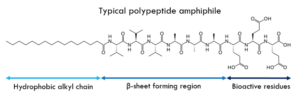
Fig. 1: Typical polypeptide amphiphile structure investigated in the paper. This example has formula C16H31O- (Val)3-(Ala)3-(Glu)3. The hydrophobic alkyl chain, β-sheet forming peptide and bioactive residues are labelled.

The stiffness of the gel matrix was tailored by adjusting the chemical structure of the β-sheet forming region of the PAs. This method was chosen because in self-assembly, the PAs first aggregate by hydrophobic collapse, then form the nanofibers as a result of the secondary structure caused by the alignment of β-sheets. The outer peptide is tailored for biological signalling and for control over self-assembly by ionisation of side-chains. The β-sheets are the main regulator of the fibre structure, and forces between sheets dictate the rigidity of the fibre. Valine highly favours β-sheet formation, and alanine favours α-helix formation. By varying the sequencing and length of the valine/alanine peptide, the β-sheets are distorted and hydrogen bonding between layers is affected, altering the stiffness of the entire gel matrix. 
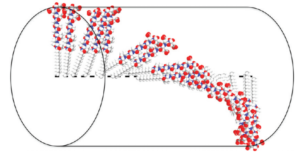
Fig. 2: Representation of the twisted geometry in polypeptide amphiphile nanofibers due to β-sheet distortions.

Circular dichroism was used to confirm distortion to the β-sheets by observing a red-shift relative to the expected signal. The distortions lead to an angling of sheets relative to one another, which results in the PAs forming a twisted geometry around the central axis of the fibre as illustrated in figure 2. A combination of Fourier transform infrared spectroscopy (FTIR) and rheological analysis indicated PAs which form stiffer gels tend to have their internal hydrogen bonds aligned with the fibre axis, which is consistent with distortions to the β-sheets decreasing fibre stiffness. It is also possible that the twisted geometry may have affected the fibre length and entanglement, however this was not able to be studied in this paper due to technical limitations. The paper found that all factors tested, including β-sheet length, valine-alanine ratio, and sequencing of the amino acids, affected the gel stiffness to varying degrees. Combining these was shown to be a highly effective method of tuning gel stiffness, and a step towards improved tissue scaffoldings for regenerative medicine.

References

Pashuck, E. T., Cui, H., & Stupp, S. I. (2010). Tuning Supramolecular Rigidity of Peptide Fibers through Molecular Structure. J. Am. Chem. Soc. Journal of the American Chemical Society, 132(17), 6041-6046. doi:10.1021/ja908560n

Template: Excerpt (Generated)

This is the post content. It should be displayed in place of the auto-generated excerpt in single-page views. Archive-index pages should display an auto-generated excerpt of this content. Depending on Theme-defined filters, the length of the auto-generated excerpt will vary from Theme-to-Theme. The default length for auto-generated excerpts is 55 words, so to test the excerpt auto-generation, this post must have more than 55 words.

Be sure to test the formatting of the auto-generated excerpt, to ensure that it doesn’t create any layout problems. Also, ensure that any filters applied to the excerpt, such as <code>excerpt_length</code> and <code>excerpt_more</code>, display properly.

Fibre Optics in 5 Minutes

“How shall we cross the river?” asked Dorothy.

“That is easily done,” replied the Scarecrow. “The Tin Woodman must build us a raft, so we can float to the other side.”

So the Woodman took his axe and began to chop down small trees to make a raft, and while he was busy at this the Scarecrow found on the riverbank a tree full of fine fruit. This pleased Dorothy, who had eaten nothing but nuts all day, and she made a hearty meal of the ripe fruit.

But it takes time to make a raft, even when one is as industrious and untiring as the Tin Woodman, and when night came the work was not done. So they found a cozy place under the trees where they slept well until the morning; and Dorothy dreamed of the Emerald City, and of the good Wizard Oz, who would soon send her back to her own home again.

Our little party of travelers awakened the next morning refreshed and full of hope, and Dorothy breakfasted like a princess off peaches and plums from the trees beside the river. Behind them was the dark forest they had passed safely through, although they had suffered many discouragements; but before them was a lovely, sunny country that seemed to beckon them on to the Emerald City.

To be sure, the broad river now cut them off from this beautiful land. But the raft was nearly done, and after the Tin Woodman had cut a few more logs and fastened them together with wooden pins, they were ready to start. Dorothy sat down in the middle of the raft and held Toto in her arms. When the Cowardly Lion stepped upon the raft it tipped badly, for he was big and heavy; but the Scarecrow and the Tin Woodman stood upon the other end to steady it, and they had long poles in their hands to push the raft through the water.

They got along quite well at first, but when they reached the middle of the river the swift current swept the raft downstream, farther and farther away from the road of yellow brick. And the water grew so deep that the long poles would not touch the bottom.

“This is bad,” said the Tin Woodman, “for if we cannot get to the land we shall be carried into the country of the Wicked Witch of the West, and she will enchant us and make us her slaves.”